
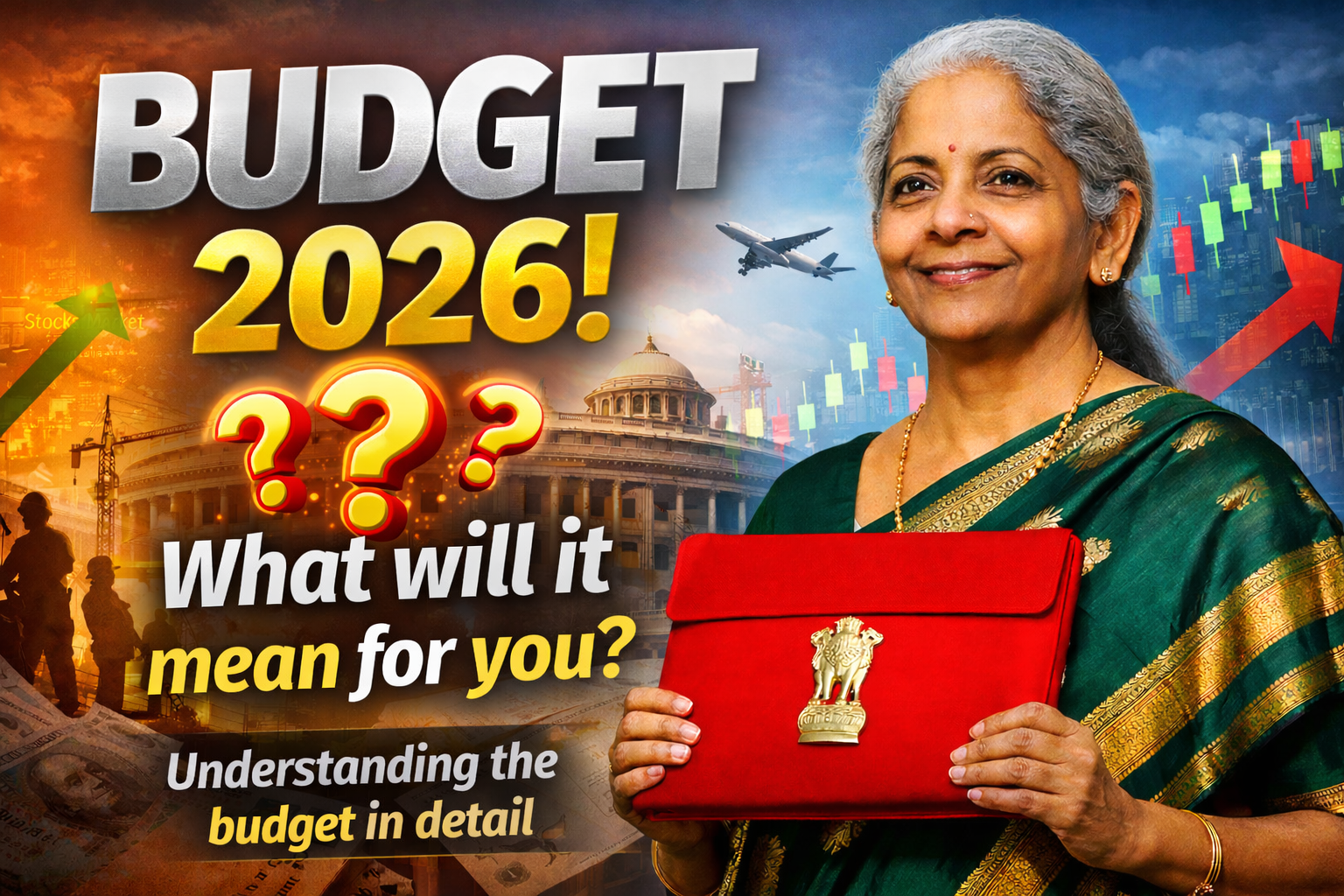
Budget 2026: Future-Focused, But the Middle Class Still Waiting?!
Every year, there is one day when India pauses. Televisions are switched on across households, WhatsApp groups turn into finance panels, young professionals scroll Budget highlights, and even senior citizens listen carefully to every announcement.
Budget Day has now become a national ritual. And honestly, that is a beautiful change.
Because the Union Budget is no longer only for economists or finance experts. It is for every taxpayer, every middle-class family, every student, every investor because this is where we understand one big question: “Where is India going next?”
Budget 2026 felt more like a long-term blueprint. India’s focus this year is clearly on building the foundation for the next decade rather than offering short-term giveaways.
The strongest message from this Budget is India’s push towards the future especially through technology and infrastructure.
A major highlight is the country’s ambition to lead in Artificial Intelligence and emerging technologies. The government is not just talking about using AI, but building India’s own ecosystem from AI missions to digital tools aimed at supporting farmers. The intention is clear: India wants to become a creator of technology, not just a consumer.
Alongside this, the government has continued its heavy focus on infrastructure spending, with capital expenditure rising to ₹12.2 lakh crore.
Many people often wonder: Why does the government spend so much on roads, railways, freight corridors, ports, and city development?
Because the capital expenditure, or capex, is not an expense that disappears quickly. When the government builds a road, it creates jobs for workers, demand for cement and steel, opportunities for businesses, better connectivity for trade, and growth that lasts for years.
Revenue expenditure, on the other hand, is spending on salaries, subsidies, pensions, and schemes. It helps in the short term, but it gets consumed quickly.
Capex builds assets. Revenue spending maintains the present. With more foreign companies investing and setting up operations in India, improving infrastructure becomes even more important. Better roads, ports, and transport systems help goods move faster, reduce costs, boost exports, and create stronger trade opportunities globally.
That is why India is prioritising capex because the government wants long-term growth, stronger GDP momentum, and global competitiveness.
Budget 2026 also strengthens the “Make in India” vision through strategic manufacturing. Sectors like semiconductors, electronics, biopharma, and rare earth processing are being scaled up with large allocations. The goal is to reduce import dependence and make India a global manufacturing hub.
Small businesses and MSMEs, which are the backbone of middle-class employment, have also received support through a ₹10,000 crore SME Growth Fund. This is a quiet but powerful move because MSMEs generate jobs, exports, and income stability across India.
Another strong focus this year is attracting global business into India, especially through GIFT City. A tax holiday till 2047 for foreign cloud service providers operating from India signals that India wants to become a global hub for finance, data infrastructure, and international business services.
So in many ways, Budget 2026 is India preparing for the next decade of technology-led, infrastructure-driven, globally competitive economy. But while the future-focused approach is impressive, there are a few areas where the middle class felt left behind.
The biggest disappointment is that personal income tax slabs have seen no major change. Many people are asking: Why didn’t the government reduce taxes further?
Think of it like running a household. If you reduce your income today, you may feel some relief but you also have less money left for big future goals. The government is trying to manage multiple priorities at once:
- Keeping the fiscal deficit under control (fiscal deficit target at 4.3% of GDP for the 2026-27 fiscal year)
- Paying for essential services
- Investing heavily in long-term growth areas like infrastructure, AI, manufacturing, and defence
The government wants to borrow less than it used to, but still keep enough money to build infrastructure. This means no big tax cuts right now, because reducing taxes would shrink revenue and make it harder to meet the deficit target while still investing in growth. Therefore, this Budget is less about short-term spending boosts, and more about building long-term capacity for India’s future.
Another major surprise was the increase in Securities Transaction Tax (STT) on Futures and Options. Markets reacted sharply on Budget Day because this was unexpected.
The government’s reasoning is understandable - This is applicable to retail participation in F&O, not any other trading or stocks. F&O has led to heavy losses in recent years, and this move is meant to discourage risky speculation and push investors toward healthier long-term investing avenues like mutual funds, etc.
Interestingly, markets corrected themselves within just 24 hours. The Budget Day fall was emotional, but the bounce-back showed that India’s long-term growth story remains intact.
Another hidden positive was the buyback taxation reform, which benefits investors more than companies. It discourages excessive buybacks and encourages transparent shareholder rewards like dividends - a pro-investor step that many missed in the headlines.
One concern worth noting is the uneven regional focus. Some industrial corridors and strategic projects highlight specific states, while Kerala did not receive similar direct mention. Hopefully, balanced development will be addressed as the Budget evolves before final passing.
But the real takeaway from Budget 2026 is that India is building for the long term with AI leadership, manufacturing strength, infrastructure expansion, and global investment confidence.
Yes, the middle class may still be waiting for stronger direct tax relief, but understanding the Budget is important because it reminds us of one key truth: As investors and as middle-class earners, we can’t control every policy decision but we can control how we respond.
Budgets decisions will come and go based on the economic situations and markets will react, correct, and recover. India’s growth story remains intact and the future is being shaped right now. It's our decision to be a part of this journey and build wealth through patience, awareness, and consistency.
Follow me and get in touch if you wish you start or align your portfolio in the right direction and drop your comments to what you think about the Budget 2026.
Akash Neelakantan Salvady
Wealth Manager at IFS